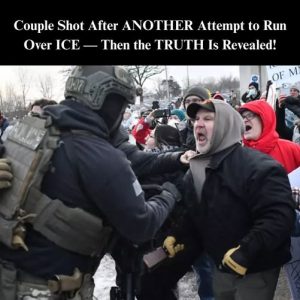
A shooting involving U.S. Border Patrol agents in Portland, Oregon, has become a focal point of a much larger national conversation about law enforcement, immigration, public safety, and the role of federal authority in local communities. The incident unfolded on a weekday afternoon, the kind of ordinary moment when people are driving home from work, picking up children, or running errands, when suddenly sirens and emergency vehicles transformed a routine street into a scene of confusion and fear. According to the Department of Homeland Security, federal agents were attempting a targeted vehicle stop connected to suspected members of Tren de Aragua, a Venezuelan transnational gang that authorities say has been expanding its criminal footprint across parts of the United States. The stop was intended to be precise and controlled, but officials say it escalated rapidly when the driver allegedly tried to use the vehicle as a weapon. In response, one of the agents fired defensively, striking both the driver and the passenger. Both individuals reportedly fled before being taken to a hospital, leaving behind a trail of unanswered questions. For many Americans, this was not just another police shooting; it was a moment that collided with ongoing debates about immigration, gang violence, and the growing visibility of federal agents in cities that often resist their presence. Portland, a city with a long history of protest and skepticism toward federal law enforcement, became the latest stage for a drama that is as political as it is procedural. What might have been handled quietly a decade ago now unfolded in front of a nation primed to react, interpret, and argue in real time.
The Department of Homeland Security’s account of the shooting has emphasized the danger its agents faced and the alleged criminal background of the individuals involved. Spokeswoman Tricia McLaughlin said agents identified themselves clearly and attempted to carry out a lawful stop when the driver accelerated, turning the car into what officials describe as a potentially lethal threat. From their perspective, the use of force was a split-second decision made in the face of imminent danger, something they argue officers are trained for and legally permitted to do. DHS has also alleged that the passenger was connected to Tren de Aragua’s prostitution network and to a recent shooting in Portland, while the driver is believed to be an active gang member. These claims are intended to contextualize the incident within a broader fight against organized crime, portraying federal agents as the thin line standing between violent networks and everyday residents. Yet even as these details were released, many people in Portland and beyond questioned the narrative. Portland Police confirmed that federal agents were involved but said city officers did not participate, highlighting the sometimes uneasy relationship between local and federal law enforcement. The fact that both suspects were wounded and initially fled added to the uncertainty, leaving residents to wonder what exactly happened in those critical moments. In an age when body cameras, dash cams, and bystander videos often surface within hours, the absence of clear, publicly available footage has only deepened speculation and mistrust.
What has made the Portland shooting especially volatile is its proximity to another high-profile case in Minneapolis, where an ICE agent killed Renee Nicole Good just one day earlier. That case had already ignited protests, grief, and intense debate over federal enforcement tactics and the use of deadly force. In Minneapolis, authorities claimed Good attempted to ram an agent with her vehicle after a prolonged confrontation, labeling the incident domestic terrorism, a description her family and civil-rights advocates strongly rejected. The timing of the two shootings, both involving vehicles and federal agents, created an emotional and political echo that reverberated across the country. To many observers, it felt as though a pattern was emerging, one in which federal officers were increasingly involved in violent encounters in local neighborhoods, raising questions about training, oversight, and accountability. For families who had just begun to mourn Good, news of another shooting so soon after felt like salt in a fresh wound. For supporters of aggressive enforcement, the Portland incident reinforced their belief that agents are facing unprecedented dangers from organized criminal groups that do not hesitate to use vehicles, weapons, or intimidation to evade capture. These two narratives now exist side by side, each feeding off the other, and each shaping how different communities interpret what happened on that Portland street.
Transparency, or the perceived lack of it, has become one of the most contentious aspects of the Portland case. The FBI’s Portland office briefly posted a statement confirming the shooting, only to delete it shortly afterward, a move that immediately drew suspicion from civil-liberties groups and members of the public. In a media environment already rife with distrust, such a retraction can feel less like a routine correction and more like an attempt to control the narrative. Advocates for independent oversight have argued that when federal agencies investigate themselves, public confidence suffers, particularly in cases involving serious injuries or loss of life. They are calling for outside review, full release of body-camera footage, and clear timelines for any findings. Supporters of federal law enforcement counter that premature disclosures can jeopardize ongoing investigations, put officers at risk, and spread misinformation. This clash between the desire for immediate transparency and the need for careful, methodical review is not new, but it has become more pronounced as technology and social media accelerate the pace at which stories spread. Every hour without new information is filled with speculation, opinion, and often anger, making it harder for any official account to regain credibility once it is finally released.
Political leaders have also entered the fray, adding yet another layer to an already complex situation. Vice President JD Vance criticized media coverage that he says undermines trust in federal agents, arguing that sensational or one-sided reporting can make it harder for officers to do their jobs and for the public to understand the real risks they face. Homeland Security Secretary Kristi Noem echoed that sentiment, defending law enforcement and emphasizing that officers are trained to respond decisively when confronted with what they believe to be imminent threats. She also reiterated the administration’s stance that obstruction of federal operations, particularly when it involves violent resistance, can rise to the level of domestic terrorism. These statements have been applauded by those who prioritize a tough stance on crime and immigration enforcement, but they have also drawn criticism from those who worry that such rhetoric may be used to justify excessive force or to stigmatize communities. In Portland, where skepticism of federal authority runs deep, these national-level defenses have done little to calm local anxieties. Residents are less concerned with abstract policy arguments and more focused on what happened in their streets, to their neighbors, and to the people who now lie in hospital beds.
Beyond the immediate details of the Portland shooting lies a broader struggle over how the United States should balance immigration enforcement, public safety, and civil rights. Federal authorities argue that transnational gangs like Tren de Aragua pose a serious threat, bringing violence, exploitation, and organized crime into American cities. They say that without robust federal action, these networks can flourish, harming both immigrant communities and the wider public. Critics, however, caution that aggressive tactics can backfire, driving fear, eroding trust, and making it harder for local residents to cooperate with police. When people see federal agents as an occupying force rather than as protectors, they may be less likely to report crimes or provide information, ultimately undermining the very safety enforcement is meant to achieve. The Portland incident, like the one in Minneapolis, sits at this uneasy intersection, where genuine concerns about crime collide with equally real concerns about overreach and accountability. As investigations continue and more facts emerge, the country will likely remain divided, each side interpreting the same events through vastly different lenses. What is certain is that shootings like this leave lasting marks, not just on those directly involved but on the collective psyche of communities and a nation still struggling to define what justice, safety, and fairness should look like in a deeply polarized era.