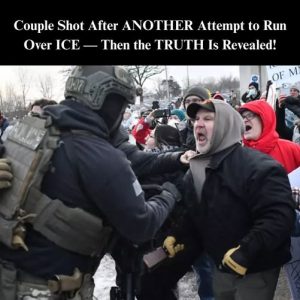
Blood hit the pavement before facts ever reached the microphones, and in that gap between violence and verification, outrage rushed in to fill the silence. Within minutes, grainy images and fragmented eyewitness claims began circulating online, stripped of context and amplified by emotion. Within hours, cable news panels were assembled, social media feeds flooded with certainty, and press releases drafted as though the investigation had already concluded. The federal shooting in Portland became less an event to be understood and more a symbol to be wielded. Politicians spoke not with caution, but with confidence that exceeded their knowledge. Activists mobilized with slogans ready-made for an incident that had not yet been explained. Headlines framed the story in moral absolutes, rewarding speed over accuracy. The public was not invited to wait for facts or to tolerate uncertainty; it was encouraged to react immediately, decisively, and emotionally. In the modern media ecosystem, delay is treated as failure, while restraint is often interpreted as complicity. The first version of the story—however incomplete—became the foundation upon which outrage was built, long before investigators had secured the scene or interviewed all witnesses.
As the hours passed, assumptions hardened into convictions. The shooting was swiftly described as an immigration raid gone wrong, an emblem of federal overreach and unchecked force, despite the absence of confirmed details. Questions that should have been central—who fired first, whether the suspects were armed, what intelligence agents were acting on, and whether an immediate threat existed—were largely ignored in favor of declarative statements. Fury moved faster than verification, propelled by algorithms designed to reward outrage and certainty rather than nuance. Those who urged patience were dismissed as defenders of the indefensible, while speculation was elevated to truth through repetition. In this environment, skepticism was not seen as thoughtful but as morally suspect. The story ceased to be about a specific encounter in Portland and instead became a vessel for broader grievances, fears, and political identities. Once that transformation occurred, facts were no longer sought to understand events, but to confirm preexisting beliefs. Complexity was treated as an inconvenience, and uncertainty as an enemy.
When investigators later confirmed that Customs and Border Protection—not Immigration and Customs Enforcement—had conducted the Hazelwood operation, the revelation arrived quietly, almost awkwardly, as though it were an interruption rather than a correction. The distinction mattered legally, operationally, and structurally, but by then, the emotional verdict had already been rendered. Many outlets reported the update briefly, if at all, while others buried it beneath layers of commentary that preserved the original framing. For much of the public, the clarification barely registered, because the initial accusation had already taken root. This imbalance—where allegations explode and corrections whisper—is one of the defining pathologies of contemporary discourse. Once a narrative settles into public consciousness, it becomes remarkably resistant to change, even when contradicted by evidence. The truth does not merely arrive late; it arrives exhausted, forced to compete with outrage that has already claimed the spotlight.
Portland’s mayor emerged as one of the most visible figures in this rush to judgment. Before investigators released findings, before body-camera footage was reviewed, and before forensic analysis was complete, he invoked the language of federal “militarization,” threatened legal action, and explicitly tied the shooting to national immigration policy. These statements carried institutional authority, signaling to residents, journalists, and activists alike that the moral conclusion had already been reached. Yet at that moment, there was no verified account of the encounter that led to gunfire. Whether the suspects were armed, whether agents faced imminent danger, and whether lethal force was justified remained open questions. Leadership, however, chose symbolism over restraint, reinforcing a narrative aligned with political posture rather than evidentiary process. In doing so, it narrowed the space for honest inquiry and made any later correction appear not as clarification, but as retreat.
Local law enforcement, acutely aware of the political realities of operating in a sanctuary city, moved quickly to distance itself from immigration enforcement altogether. Statements emphasized separation, non-cooperation, and moral distinction, even though the incident did not involve their department. This reflexive distancing may have been politically expedient, but it further blurred public understanding of what had actually occurred. Federal officials, meanwhile, urged restraint, calling for a comprehensive review of body-camera footage, ballistic evidence, radio transmissions, and witness testimony. Their tone was measured, procedural, and deliberately cautious—qualities essential to any credible investigation. Yet in a climate where silence is interpreted as guilt and patience as evasion, such restraint struggled to compete with the immediacy of outrage. The slow, methodical nature of fact-finding appeared inadequate not because it was flawed, but because it did not satisfy the public’s demand for instant moral clarity.
This pattern was not unique to Portland. It echoed a familiar sequence seen in other high-profile incidents across the country, including a Minneapolis shooting weeks earlier, where early claims dominated headlines and fueled protests long before video evidence emerged and complicated the initial story. In that case, as in others, early narratives unraveled under scrutiny, but the unraveling received only a fraction of the attention given to the original accusations. The public memory froze at the first version of events, while later evidence was treated as an asterisk rather than a revelation. Again and again, the same cycle played out: emotionally charged allegations, rapid political condemnation, and a belated reckoning with facts that failed to command the same intensity. Each repetition eroded trust—not only in law enforcement, but in media, leadership, and the very idea of objective truth.
What the Portland incident ultimately exposed was something deeper than miscommunication or partisan reflex. Immigration enforcement has become a political symbol first and a fact pattern second. Any incident involving federal agents is immediately absorbed into a broader ideological struggle, where details are subordinate to narrative utility. Evidence is filtered through belief rather than belief shaped by evidence. Facts are not evaluated on their merits, but on whether they support a preferred conclusion. In such an environment, truth becomes negotiable, contingent upon alignment rather than accuracy. This dynamic corrodes public discourse and undermines accountability. Federal officers may be condemned before investigations conclude, while genuine misconduct risks being obscured by exaggeration or mischaracterization. Communities grow cynical, assuming that every official statement is spin and every correction is damage control. Justice, which depends on patience and precision, is sacrificed to performance and immediacy.
The long-term consequences of this cycle are profound and destabilizing. When outrage consistently outruns evidence, institutions lose legitimacy not only because of wrongdoing, but because of the perception that truth itself is secondary to politics. Officers who acted lawfully may find their reputations permanently damaged, while victims of actual abuse may see their claims diluted by a culture of premature accusation. Public trust erodes on all sides, replaced by suspicion and fatigue. Once outrage has decided the outcome, facts arrive too late to matter, dismissed as inconvenient or irrelevant. In Portland, as in so many cases before it, the core failure was not a lack of information, but a lack of patience. Until restraint is valued as highly as reaction, and verification is treated as a moral obligation rather than a delay, blood will continue to hit the pavement long before facts reach the microphones—and the truth will always be struggling to catch up.